Designing an Affordable, Homeschool‑Friendly Home Setup

Editor’s Note:
Homeschooling looks different in every home. This article is not meant to present a “perfect” setup or a finished model to replicate. Instead, it’s intended to offer thoughtful, affordable guidance for families navigating learning at home—often while balancing work, caregiving, financial constraints, and individual learning needs. Our hope is to support, not prescribe, and to reflect the many ways real families make learning work within their own homes.
Here are ways families make this work—your version may look different, and that’s okay.
The decision to homeschool is rarely a simple decision. For many families, especially those with neurodivergent children, it comes after months or years of trying to make traditional systems work, while quietly juggling concerns about cost, time, energy, and long‑term sustainability.
Homeschooling can be deeply rewarding, but it can also be expensive. Learning materials, curriculum, adaptive tools, therapies, and the loss or reduction of income add up quickly, especially in households with more than one child. Designing a homeschool‑friendly home, then, isn’t about recreating a classroom or investing in picture‑perfect furniture. It’s about creating an affordable, flexible environment that supports learning and family life, using what you already have whenever possible.
Start With a Mindset, Not a Room
A homeschool setup doesn’t need a separate room, or even a dedicated desk, to work well. What matters most is intention. For many families, learning happens across multiple spaces throughout the day: a kitchen table in the morning, a couch for reading, a quiet corner for independent work. This flexibility is not a compromise; for neurodivergent learners, it’s often essential.
Rather than asking, Where should the homeschool room be? it’s more helpful to ask, Where does my child feel regulated, safe, and able to focus?
Affordable Furniture That Adapts Over Time
Before buying anything new, look at what you already own:
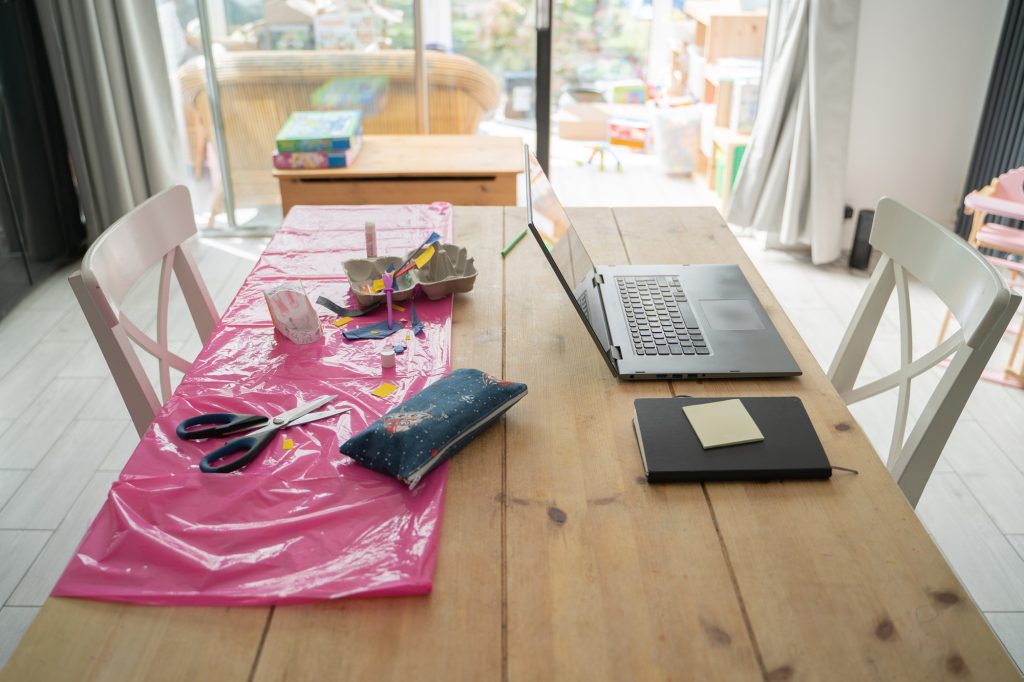
- Dining or kitchen tables can double as workspaces
- Console tables or nightstands can become desks
- Bookshelves can store both school supplies and everyday items
If you do need to add furniture, prioritize adjustability and longevity. A simple table that can grow with a child often works better than a specialized “school desk” that will be outgrown quickly. Chairs can be adapted with cushions, footrests, or movement supports rather than replaced outright.
For families homeschooling multiple children, shared work surfaces paired with individual storage bins help keep costs down while respecting each child’s independence.
Lighting and Sensory Considerations on a Budget
Good lighting is one of the least expensive ways to improve a homeschool setup.
Natural light, whenever possible, helps reduce fatigue and supports focus. When artificial lighting is needed, simple task lamps or secondhand desk lamps are usually sufficient. The goal isn’t aesthetics—it’s comfort.
For neurodivergent children, sensory awareness matters just as much:
- Avoid harsh overhead lighting
- Reduce visual clutter where possible
- Allow movement, texture, and flexibility in seating
A homeschool‑friendly home prioritizes regulation over rigidity.
Storage That Supports Independence (Without Overspending)
Organization doesn’t have to be elaborate to be effective.
Affordable, accessible storage options include:
- Open bins or baskets
- Labeled boxes by subject or child
- Portable caddies that travel from room to room
When children know where materials live and can access them independently, learning becomes less stressful for everyone. Simple systems are easier to maintain long‑term—especially in homes already managing complex needs.
Designing With Neurodivergent Learners in Mind
For many families, homeschooling is considered or chosen because traditional learning environments don’t adequately support a child’s needs. Neurodivergent children may require learning setups that allow for movement, alternative communication, sensory regulation, or flexible pacing.
A homeschool‑friendly home doesn’t require isolating these needs in a separate room or purchasing specialized furniture. Often, it simply means allowing learning tools—such as AAC devices, sensory supports, or movement aids—to exist naturally within shared living spaces.
When these tools are integrated rather than hidden away, children are supported without being singled out, and learning becomes part of everyday life instead of something that requires constant transition. The goal is not to “optimize” the space, but to reduce friction and help children feel safe, regulated, and capable.
Special Education as support, not contradiction
For some families, a homeschool‑friendly setup is not a preference so much as a necessity, especially when a child’s learning needs have not been met in traditional settings. It may help to know that choosing to educate at home does not mean forfeiting all forms of support. In many places, special education services, evaluations, or accommodations can still exist alongside homeschooling, offering families additional tools rather than added control. These supports are not an admission that a home environment is insufficient; they are one more way families piece together care in systems that rarely arrive whole. For parents navigating neurodivergence, disability, or learning differences, knowing that help can coexist with independence can ease some of the pressure to do everything alone.
Social skills as lived practice
Social skills are not developed in a single room or during a single part of the day. They grow through ordinary interactions, negotiating space, sharing attention, navigating frustration, and learning how to be with others across different ages and settings. In homeschool environments, this often looks less like a classroom and more like everyday life: conversations at the table, time spent in libraries or community spaces, shared responsibilities, and relationships that extend beyond peer‑only groups. Research has shown that children educated at home can develop strong social and emotional skills when parents are intentional about connection and exposure, not because homeschooling guarantees social success, but because social growth is treated as something ongoing and relational rather than automatic or outsourced. What matters most is not the building children learn in, but whether their lives include opportunities for belonging, communication, and practice over time.
Resource Box Copy
Supportive Resources Families Often Turn To
Editor’s note: This list is intentionally broad. Families’ needs, budgets, and access vary widely.
These resources are not requirements, but many families find them helpful when exploring or sustaining homeschooling.
- Libraries and digital lending programs – Many offer free curriculum materials, audiobooks, and educational databases.
- Local homeschool co‑ops – Often low‑cost or shared‑resource communities that reduce isolation.
- Public advocacy organizations – Groups that provide general guidance on homeschooling laws and options by region.
- Assistive technology information hubs – Educational organizations that explain AAC and adaptive tools without selling products.
- Parent networks and support groups – Online or local spaces where families share experiences rather than prescriptions.
- Teachers Pay Teachers (TPT) is a marketplace of teacher‑made materials that homeschool families commonly use to adapt lessons, fill gaps, or meet specific learning needs at low cost or for free. It’s explicitly recognized in homeschool resource guides as a place families turn to for worksheets and lesson plans across grades and subjects.
- com provides worksheets, games, and structured learning activities that many families use to support K–8 learning at home, especially when they need ready‑to‑use materials without designing everything from scratch.
Making Space for Real Life
One of the hardest parts of homeschooling is that learning doesn’t happen in isolation. It unfolds alongside work deadlines, caregiving, appointments, therapies, shared meals, and the quiet unpredictability of daily life. Many families are balancing more than one role at a time, parents working from home while teaching, multiple children learning together across ages, or entire households reorganizing space throughout the day to make room for different needs. A homeschool‑friendly home acknowledges this reality. It allows for breaks, messes, movement, and quiet without treating them as interruptions. It accepts that some days learning happens at the table, some days on the floor, and some days in fragments between other responsibilities—and that this variability is not a failure. An affordable setup doesn’t just protect your budget. It protects your energy by making learning flexible enough to live inside real life, rather than compete with it.
A Final Thought
Many families want to homeschool but feel locked out by cost, space constraints, or the fear of “doing it wrong.” That fear often comes from imagining homeschooling as something fixed or finished, a setup that must be perfected before learning can begin. In reality, meaningful learning grows the same way families do: gradually, unevenly, and in response to real circumstances. It shifts as children change, as work schedules evolve, as needs become clearer, and as confidence builds.
An affordable homeschool setup is not one that looks impressive on day one, but one that can live with you over time. It makes room for trial and error, for seasons of more structure and seasons of improvisation. It reflects your family’s values, rhythms, and goals rather than someone else’s ideal. When a learning environment fits your actual life, your energy, your space, your children, it becomes sustainable.
Homeschooling does not require getting everything right. It asks for consistency, compassion, and flexibility, offered repeatedly. Start small, use what you have, and allow your home to become a learning space in ways that feel natural rather than forced. The right environment is the one that grows with your family, supporting both who you are now and who you are becoming together.
This article is part of the Childhoods & Everyday Life section of The Children’s Planner, which explores how children learn and grow within the ordinary realities families navigate every day.